How 'Three-Legged Willie' gave Williamson County its name
A peg-legged judge who fought at San Jacinto never settled here, yet his name is on every WilCo deed. Here's how the county got it in 1848.
· 4 min read
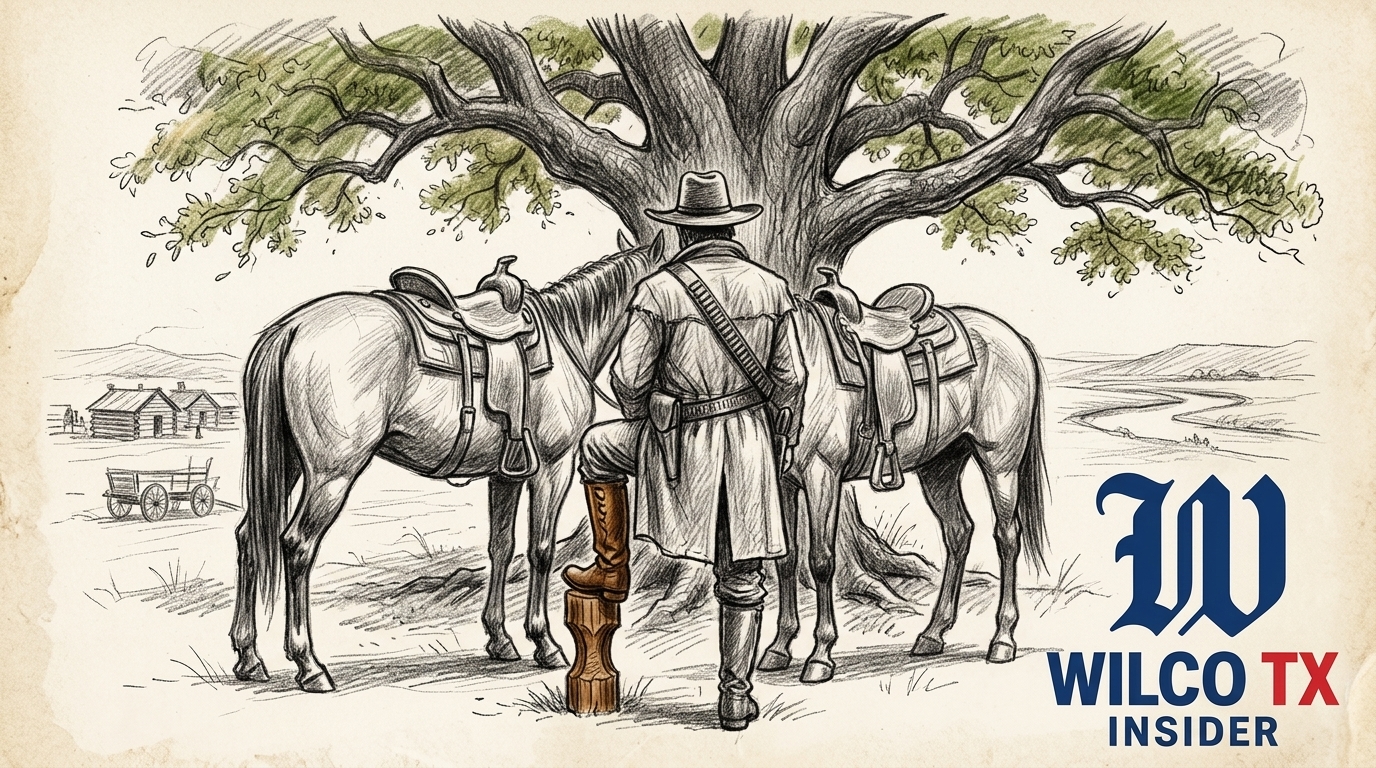

Picture a young lawyer riding into Mexican Texas in the late 1820s. He is said to be a capable horseman and a skilled marksman. But his right leg is bent sharply at the knee, and a wooden leg is strapped below it, so he walks on three points instead of two.
Settlers gave him a nickname that stuck for life: "Three-Legged Willie." His real name was Robert McAlpin Williamson, and every time you write "Williamson County" on a form, you are writing his name.
So how did a judge from San Felipe end up as the namesake of the county we call home?
A boy from Georgia with a bent leg
Williamson was born in Georgia. Even the year is uncertain: some records say 1804 and others say 1806, and the Texas State Cemetery lists both. At about 15, a disease left his right leg locked at the knee. The Texas Historical Commission's marker at Anahuac says that is how he came to wear a peg leg and earn his nickname.
He studied law while he was sick and was practicing in Georgia by about age 19. Then he headed west to Stephen F. Austin's colony. Accounts differ on the year: his headstone says 1826, while the state's Anahuac marker says he settled in Texas in 1827.
Editor, lawyer and rebel
In 1829 Williamson helped start a newspaper at San Felipe called The Cotton Plant. He later edited The Texas Gazette and The Mexican Citizen. He also became the area's first prosecuting attorney.
By 1832 tension with Mexican authorities was rising. At Anahuac, on Galveston Bay, commander Juan Davis Bradburn had jailed two Anglo lawyers, William B. Travis and Patrick C. Jack. According to the state's marker there, Williamson confronted Bradburn over the arrests. His state-erected headstone in Austin lists his stand against Bradburn at Anahuac in 1832 among the milestones of his life.
When the Texas Revolution came, he was named a major of the Texas Rangers. He fought at San Jacinto in April 1836, the battle that won Texas independence.
The judge who rode the circuit
After the war Williamson became a district judge and one of the original justices of the Republic of Texas Supreme Court. Later he served in the Republic's Congress and, after statehood in 1845, in the Texas Legislature.
Frontier judges traveled from county to county to hold court, and plenty of tall tales grew up around "Three-Legged Willie." The best-known one is a legend, and it changes depending on who tells it. In it, a rough crowd challenges the judge's authority, and he sets a Bowie knife on the bench and calls it the constitution that overrules the law. The state's Anahuac marker tells it only as something that "is said to" have happened, and no record from the time confirms it. Enjoy it as a legend, not as history.
A county carved from Milam
By the 1840s, settlers were spreading along the San Gabriel River and Brushy Creek in what was then western Milam County. They petitioned the Legislature, and on March 13, 1848, lawmakers created Williamson County, according to a 2023 Texas Senate resolution marking the county's 175th birthday and the Texas Historical Commission's courthouse marker. (An older 1936 marker gives the date as March 12.)
The new county was named for Williamson, the San Jacinto veteran and Supreme Court justice. The marker outside the Williamson Museum says he believed Texas counties should be named for Texas heroes. In the end, one was named for him.
A county seat under an oak tree
The county still needed a seat. According to local tradition, recorded on the state's "Founding of Georgetown" marker, the first county commissioners met under a large oak in May 1848. Landowner George Washington Glasscock offered land that ran from that oak to the San Gabriel River.
Glasscock, who co-owned the land with Thomas B. Huling, donated 172 acres for the county seat, according to his 1936 state marker. In July 1848 the commissioners named it Georgetown, after Glasscock. The oak tree stood until a storm brought it down in 1886.
The rest of Willie's story
Williamson lost a race for lieutenant governor in 1851. He married Mary Jane Edwards in 1837, and they had seven children. He died on December 22, 1859, at his father-in-law's home in Wharton.
He did not stay buried there. The Texas State Cemetery says he was reburied in Austin in 1930, and the State of Texas put up his headstone. He rests on Republic Hill, among other leaders of the Republic of Texas.
Then & now
Georgetown's courthouse square is the best place to meet "Three-Legged Willie" today. A statue of him by sculptor Lucas Adams stands on the west side of the square, outside the Williamson Museum at 716 S. Austin Ave. Look for the wooden leg.
The courthouse behind him, finished in 1910, is the county's third. The Texas Historical Commission's marker on the grounds says it cost $96,000. About a block southeast, at Church and 9th streets, the "Founding of Georgetown" marker tells the story of the oak tree. Glasscock has his own 1936 state marker on the south side of the courthouse.
Did you know?
- Glasscock County in West Texas is named for the same George Washington Glasscock who gave Georgetown its name, according to his 1936 marker on the courthouse square.
- Williamson County's pink granite 1936 Centennial marker once stood at a roadside park on I-35 in Round Rock. The Texas Historical Commission's Atlas says it was in TxDOT storage as of 2021.
- Williamson co-founded The Cotton Plant newspaper in 1829, nearly 20 years before the county that bears his name existed.
- Williamson received 640 acres of land for his service at San Jacinto, according to the Texas State Cemetery.
See the marker: Williamson County, Williamson County Courthouse, Georgetown.
Do you have old photos of the courthouse square or your family's WilCo roots? Share them at wilcotxinsider.com/way-back-wilco.
Get local stories like this in your inbox by subscribing to The Scout Report at wilcotxinsider.com/subscribe.
📷 Have old Williamson County photos? Share them with Way Back WilCo →
Your family’s old photos could be part of a future story. Here’s what helps most:
- Good to send: old family photos, storefronts, main streets, schools, churches, farms, rodeos, parades, sports teams, floods and storms, and anything showing how WilCo used to look.
- Tell us what you know: what it shows, where and roughly when it was taken, who’s in it, and any story behind it. A best guess is fine; just say so.
- Only send photos you took or have permission to share. Please don’t send newspaper clippings, professional studio portraits or photos from other websites.
- Be kind to people pictured: if people in the photo are living, make sure they’re OK with it being shared.
- Scanning tips: a phone photo of the print is fine. Lay it flat, use daylight, avoid glare, and fill the frame.
- You keep ownership. We’ll email you before we publish, and we always credit you.